 NEW JOURNEY
Agricultural Drone Battery Solutions for Repeated Field Operations
For an agricultural drone fleet, the useful battery is the one that supports the day’s spraying schedule. A pack that performs well on one flight can still interrupt field work if it returns too hot to charge, requires unavailable charging power or leaves too few ready packs for the next departure.
New Journey approaches agricultural drone battery projects as a combination of loaded-flight power, charging compatibility, pack rotation and repeat-order consistency. The objective is an agreed configuration that fits both the aircraft and the field operation. The fastest advertised charge rate is only one input.
Start with the loaded aircraft and the working day
Define the payload at take-off and how it changes during spraying. Include the climb, working height, route, return and landing. A partially emptied aircraft and a fully loaded aircraft can impose different loads; the sample programme should represent the demanding parts of the intended duty.
Then map the ground operation. Record the interval between departures, flight duration, inspection and cooling time, refill activity, charging duration and the number of independent charging outputs. Work carried out at the same time should not be counted twice, while a shared operator or power source may prevent assumed overlap.
| Field constraint | What to specify with the battery enquiry |
|---|---|
| Loaded take-off and climb | Battery-terminal current or power, duration, minimum acceptable loaded voltage |
| Repeated sorties | Planned departures per hour and time available between uses of the same pack |
| Hot or cold conditions | Ambient range, pack temperature on return, permitted charging-start conditions |
| Existing charging equipment | Output voltage, current, total shared power, number of outputs and communication |
| Quick replacement | Pack restraint, accessible connector, lead routing and battery identification |
| Fleet purchasing | Initial pack quantity, repeat-order batches, configuration revision and acceptance records |
Evaluate high-output candidates against the complete configuration
Golden Feather FAP10790192-22Ah and FAP105105230-30Ah are useful cell references for a discussion about high-output agricultural configurations. Their cited specifications list 3.75 V nominal voltage, a 4.35 V charge limit, 5C maximum charging, 10C maximum discharge and a 20C peak limited to 10 seconds. They have different capacity and mass, so they are not interchangeable units. S2, S3
The 22Ah cell is 411 ±5 g and the 30Ah cell is 559 ±5 g. Before selecting the larger cell, check whether its added energy serves the mission or creates an unnecessary mass and turnaround burden. Before using the peak rating, compare the actual event duration. A ten-second value does not cover a longer climb or repeated high-load events without the relevant thermal assessment.
Temperature conditions also belong in the comparison. The FAP22Ah specification states a −20–60°C charge operating range and −40–60°C discharge range. FAP30Ah states −10–60°C for charge and −20–60°C for discharge, with a −10°C charging test at 1C. A working temperature range does not establish that maximum charge or discharge current is permitted everywhere within it. Obtain the rate-by-temperature conditions for the intended pack. S2, S3
Match the charger to the cell voltage limit
A 12S configuration charged to 4.35 V per cell reaches 52.2 V. A 12S configuration using a 4.20 V endpoint reaches 50.4 V. The same series count therefore does not establish charger or aircraft compatibility.
Check the aircraft input ceiling, charge-control settings and any protection thresholds together. A customer retaining a 52 V system ceiling cannot simply accept the original 52.2 V charging configuration. A reduced endpoint or another configuration would need its own usable-energy and operating validation; it should not be treated as an invisible charger adjustment.
Plan readiness, not just charging time
Battery readiness begins at landing and ends when the pack is inspected, within permitted conditions, charged to the agreed endpoint and ready for installation. Charging includes its actual current profile and termination, not just a reciprocal C-rate estimate. The lithium-ion discussion in Texas Instruments’ Battery Charging application note explains the constant-current/constant-voltage principle and current taper; the ordered cell specification supplies the actual settings.
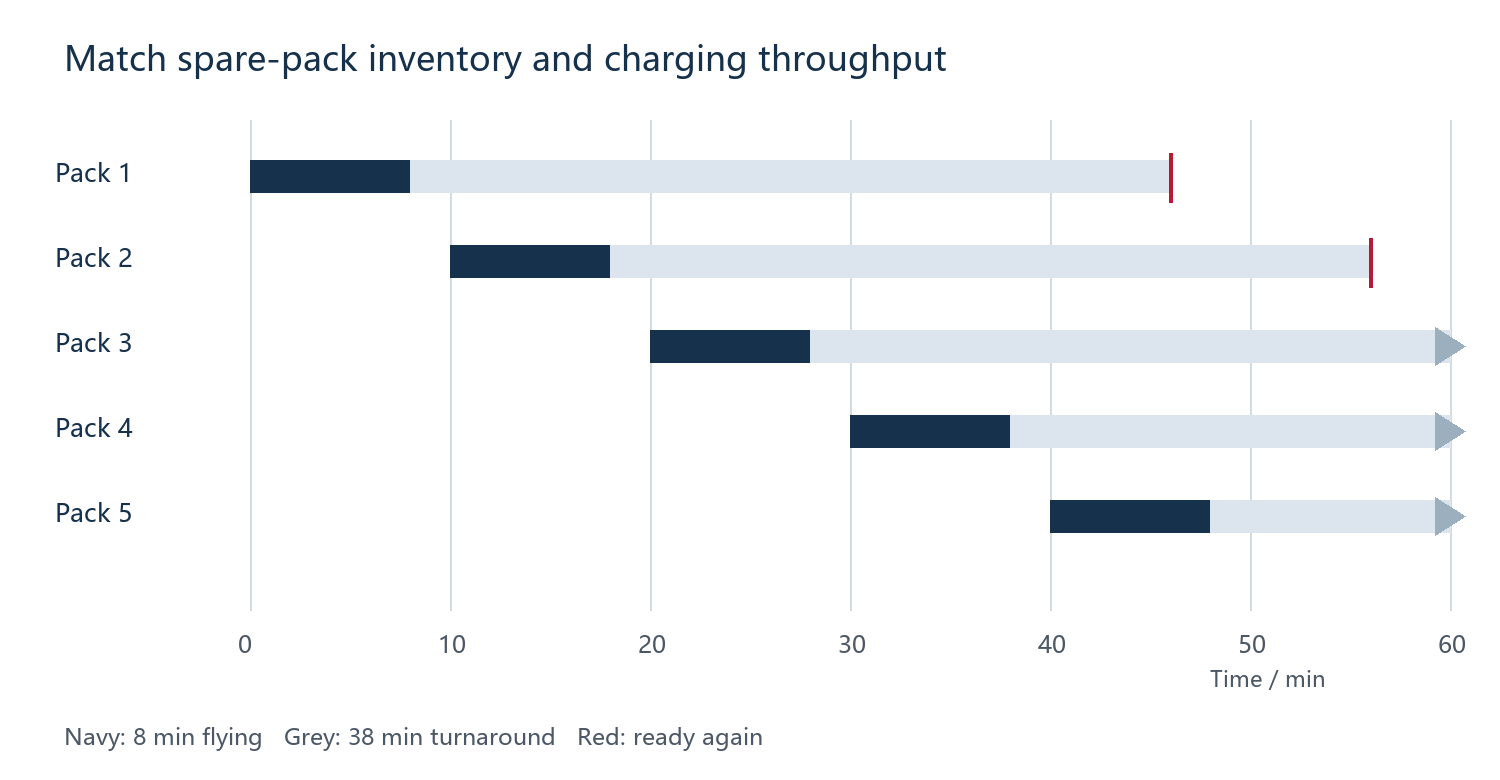
Planning illustration only. The flight, cooling, charge and handling durations are assumed inputs and must be replaced with measured values for the ordered configuration.
If a pack is available again 46 minutes after departure and flights depart every 10 minutes, the first departures at minutes 0, 10, 20, 30 and 40 need five separate packs. If charging occupies a channel for 30 minutes, maintaining that cadence requires at least three independent channels in an ideal steady schedule. Shared charger power, delays and a pack removed from service can require more capacity. The charging and spare-pack planning article works through the calculation and its limits.
Compare cost against accepted field work
A useful purchasing comparison includes the packs, chargers, power supply, handling and expected replacements. Divide by completed work under agreed operating conditions, rather than comparing the battery purchase price alone.
Supplier cycle figures should retain their test conditions. The cited FAP30Ah specification gives a cycle criterion under a defined 5C charge/10C discharge test at 25 ±3°C with specified rest periods and a capacity-retention endpoint. It is not a forecast of the number of seasons or hectares a particular fleet will complete. Agree a representative sample duty and a replacement policy for the operation. S3
Define New Journey’s project scope before samples
New Journey can help specify cell selection, series and parallel configuration, pack capacity, dimensions, leads, connectors and the required protection or communication interface. For an agricultural project, the sample brief should also identify the intended charger, loading schedule and field acceptance records.
Agree the outputs: a configuration drawing, electrical specification, charger settings, sample identification and test plan. Specify the change-approval process before repeat orders so that a connector, cell revision or charging setting is not substituted without assessment. An enclosure or connector choice should be backed by its own environmental and operating requirements rather than described as waterproof without a defined rating.
Should we buy the largest-capacity pack that fits?
Choose the capacity that supports the mission and rotation plan within the mass limit. More capacity can be useful, but should be evaluated with charging infrastructure and the aircraft’s load profile.
Does a 5C charge rating mean the pack is ready in 12 minutes?
No. It describes a permitted current under specified conditions. Starting charge, taper, temperature, balancing, termination and handling determine readiness time.
For a quotation, send the aircraft voltage window, loaded-flight data, battery-bay drawing, existing charger specification and daily sortie target. Use the project brief and contact New Journey to define the sample configuration and field trial.
Specification references
The model values cited above come from the following Golden Feather supplier documents. Use the matching approved revision for the ordered configuration.
- (S2) FAP10790192-22Ah, GF-PS-25008 A0, 2025-02-21, pp. 5–6
- (S3) FAP105105230-30Ah, GF-PS-24026 A1, 2024-11-11, pp. 5–7