 NEW JOURNEY


Product Description
The 33Ah cell is one option for a pack layout built around a 90 x 190mm footprint. Thickness is specified separately at 50% and 100% state of charge, so mechanical clearance should use the relevant condition. Capacity acceptance also needs a defined basis: the specification lists 33Ah nominal and 32Ah minimum at its stated test conditions.
Dimensions and assembly scope
The 33Ah pouch battery cell reference has a mass of 310 ± 5g and nominal energy of 122.1Wh. The 33Ah version is the thinner option within the 90 x 190mm cell family. Its capacity basis is specified at 0.1C, so compare it with other cells only after aligning the test rate and temperature. The final pack mass must also include interconnects, insulation, protection, wrapping and the harness.
Specification for Configuration Review
| Parameter | Specification / qualification |
|---|---|
| Source model | JSN8890190 |
| Product form | Pouch cell |
| Nominal voltage | 3.70V |
| Rated capacity | 33Ah |
| Nominal energy | 122.1Wh (calculated from nominal voltage and rated capacity) |
| Minimum capacity | 32Ah at 0.1C, 25 ± 2°C |
| Charge ceiling | 4.25V |
| Discharge endpoints | 2.5V above 0°C; 2.3V at or below 0°C |
| Maximum continuous charge / discharge | 33A (1C) / 132A (4C); cell basis |
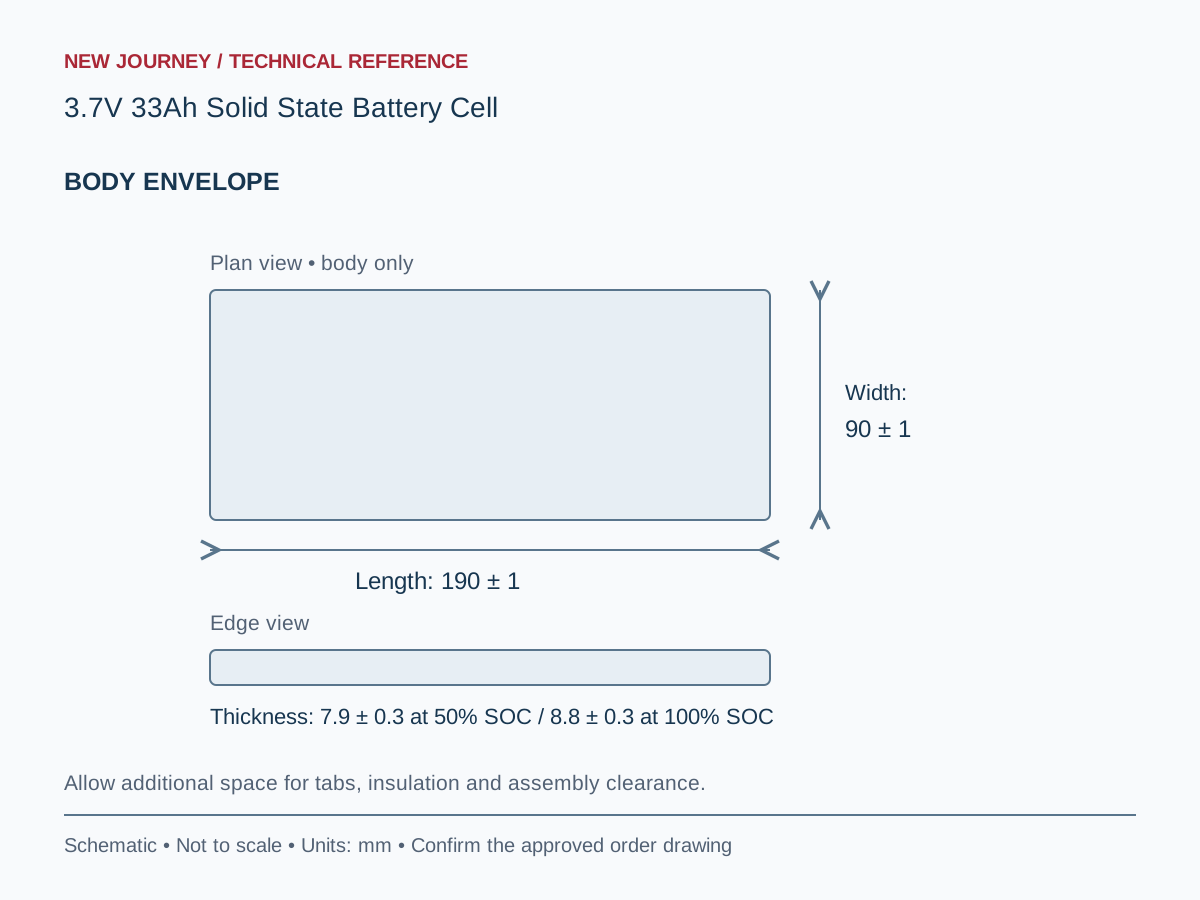
| Body length / width | 190 ± 1mm / 90 ± 1mm |
| Thickness at 50% / 100% SOC | 7.9 ± 0.3mm / 8.8 ± 0.3mm |
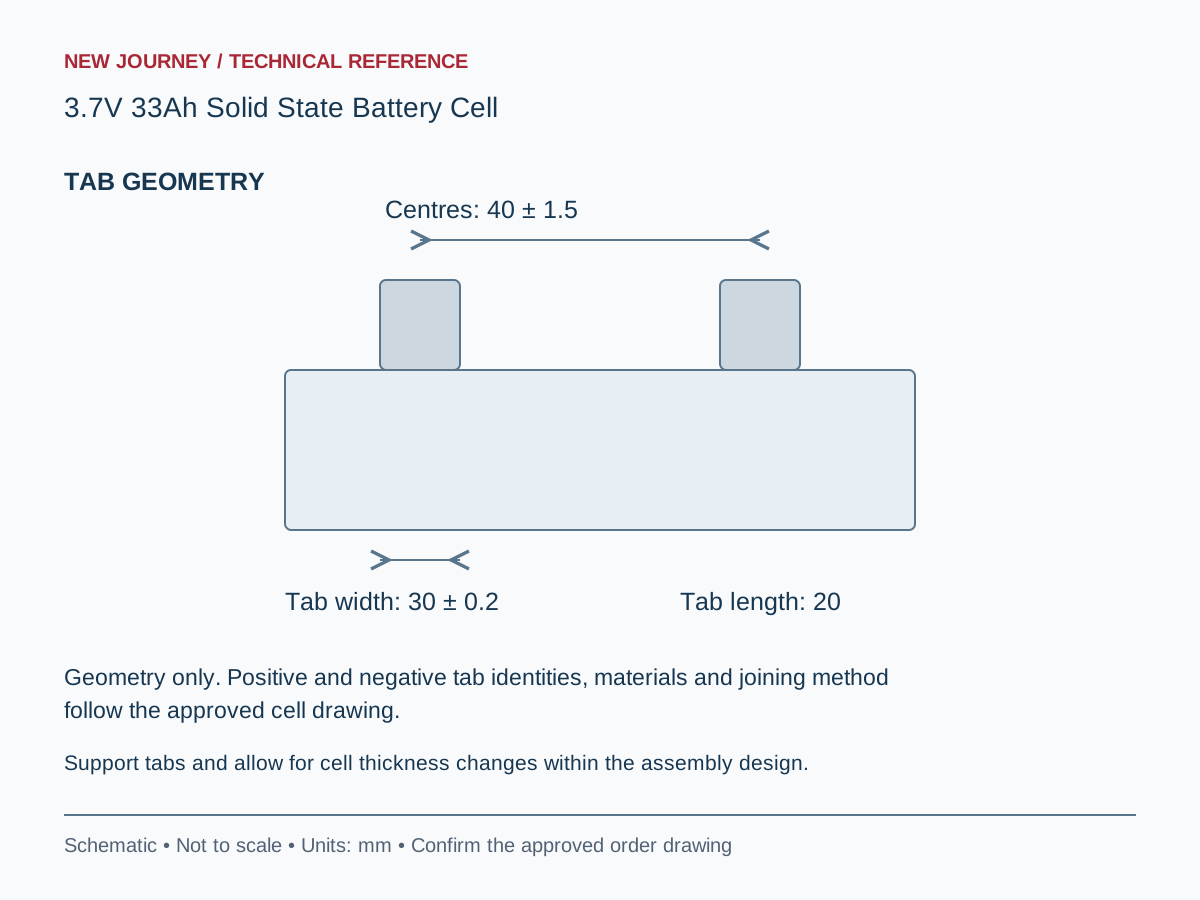
| Tab width / length / centers | 30 ± 0.2mm / 20mm / 40 ± 1.5mm |
| Reference cell mass | 310 ± 5g |
| AC impedance | ≤3mΩ at 1kHz |
| Operating temperature | Charge 0–60°C; discharge −30–60°C; maximum 90% RH |
Dimensions and tab layout
Technical views based on the dimensions in this product specification. Open either drawing to inspect the vector detail.
Allow for the state-of-charge thickness
The JSN8890190 cell drawing specifies 7.9 ± 0.3mm thickness at 50% state of charge and 8.8 ± 0.3mm at full charge. Its width is 90 ± 1mm, with a 190 ± 1mm length. Establish the assembly support and clearance from the full operating condition rather than one unloaded measurement.
Keep the electrical limits with the cell
This 3.70V high capacity battery cell uses a 4.25V charge ceiling and lists 33A (1C) maximum continuous charge and 132A (4C) maximum continuous discharge. The cell-level data does not establish the limit of an assembled UAV connector or cable. Confirm the complete power path for the planned duty.
Define tab joints and acceptance together
A solid state cell for UAV packs needs an agreed interconnect design. Here the tabs are 30 ± 0.2mm wide, 20mm long and 40 ± 1.5mm apart at their centers. Specify insulation, joining method and inspection criteria with the pack builder. The supplier classification does not by itself verify an all-solid electrolyte construction.
Related production and handling
The photograph shows related pouch-cell handling, rather than an identified 33Ah batch. Use the dimensional drawing and the agreed capacity test to approve samples.

Prepare a Product Enquiry
When enquiring about the 33Ah cell, identify the available thickness and the capacity acceptance condition. Include the intended series and parallel arrangement if pack-design support is required.
Compare 3.7V 33Ah Solid State Battery Cell with related models
| Selection point | 3.7V 33Ah Solid State Battery Cell | 3.7V 40Ah Solid State Battery Cell | 3.7V 20Ah Solid State Battery Cell |
|---|---|---|---|
| Nominal voltage | 3.70V | 3.70V | 3.70V |
| Rated capacity | 33Ah | 40Ah | 20Ah at 0.2C, 25 ± 2°C |
| Nominal energy | 122.1Wh (calculated from nominal voltage and rated capacity) | 148Wh (calculated from nominal voltage and rated capacity) | 74Wh (calculated from nominal voltage and rated capacity) |
| Maximum continuous charge / discharge | 33A (1C) / 132A (4C); cell basis | 40A (1C) / 120A (3C); cell basis | 40A (2C) / 100A (5C), cell specification |
FAQ
What makes this cell different from adjacent capacities?
The 33Ah version is the thinner option within the 90 x 190mm cell family. Its capacity basis is specified at 0.1C, so compare it with other cells only after aligning the test rate and temperature.
Is it supplied as an aircraft-ready pack?
This page describes the pouch cell. Specify series count, external harness, protection and mechanical support separately for a finished aircraft battery.
What should be checked on the sample?
Confirm dimensions at the agreed state of charge, tab geometry, capacity at the specified test rate and voltage behavior under the intended load. Use a consistent method for supplier comparison.
How are price and delivery arranged?
Provide the required cell quantity, target pack design and destination for a quotation. New Journey can review JSN8890190 availability and the applicable delivery documents for the specific order.