 NEW JOURNEY


Product Description
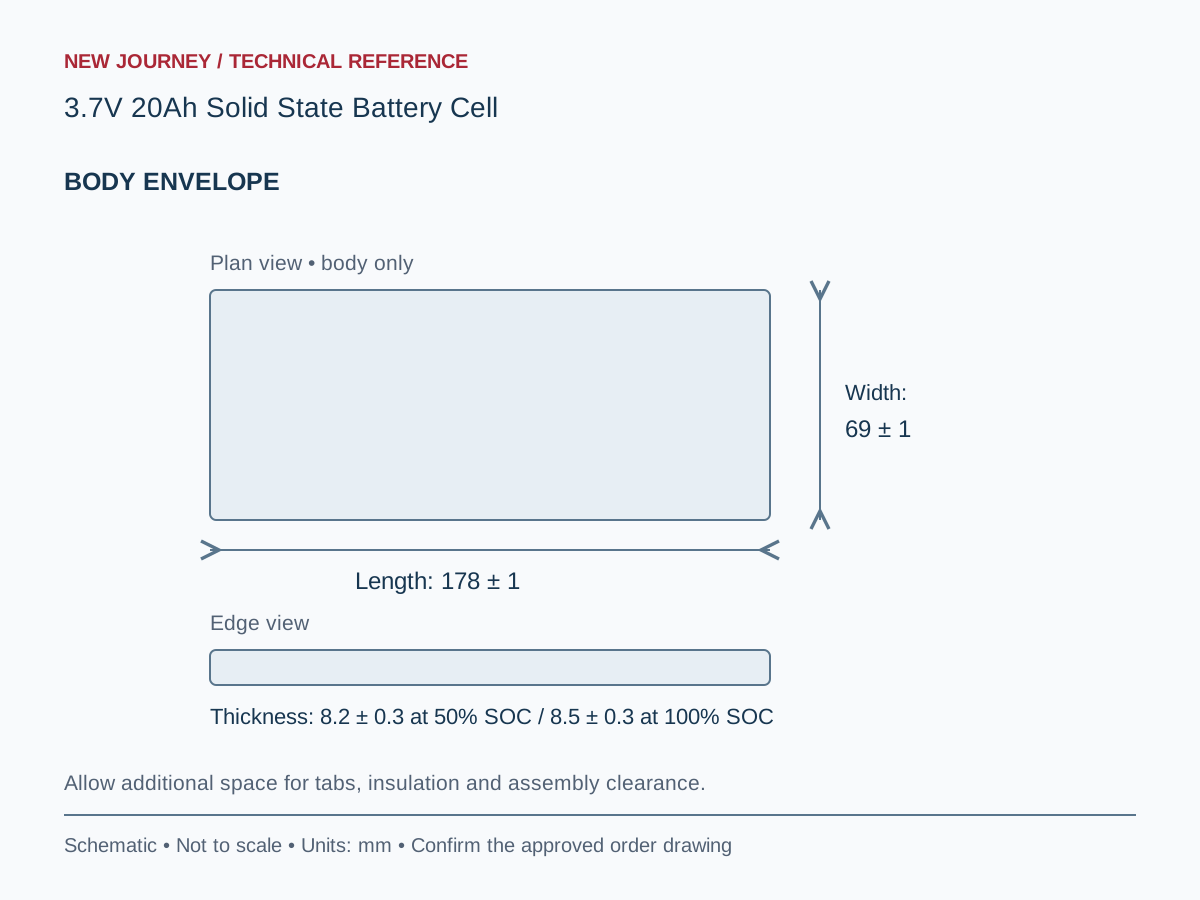
Pack designers need to know how much space remains for insulation and tab connections after selecting a cell. This 20Ah pouch format has a narrow 69mm body and a 178mm length. Its thickness changes with state of charge, so the enclosure should be checked at the specified full-charge thickness. The cell is supplied for integration into a designed battery assembly.
Dimensions and assembly scope
A 20Ah pouch cell gives the pack designer a 69mm-wide starting point. The source specifies 8.2 ± 0.3mm thickness at 50% state of charge and 8.5 ± 0.3mm at full charge. Leave assembly clearance based on the approved mechanical design rather than clamping to a single nominal thickness.
Specification for Configuration Review
| Parameter | Specification / qualification |
|---|---|
| Source model | JSN8570178 |
| Product form | Pouch cell |
| Nominal voltage | 3.70V |
| Rated capacity | 20Ah at 0.2C, 25 ± 2°C |
| Nominal energy | 74Wh (calculated from nominal voltage and rated capacity) |
| Charge ceiling | 4.25V |
| Discharge endpoint | 2.5V above 0°C; 2.3V at or below 0°C |
| Maximum continuous charge / discharge | 40A (2C) / 100A (5C), cell specification |
| Cell size | 178 ± 1 x 69 ± 1mm; thickness 8.2 ± 0.3mm at 50% SOC / 8.5 ± 0.3mm at 100% SOC |
| Tab geometry | 20 ± 0.2mm width; 20mm length; 32 ± 1.5mm center spacing |
| Reference mass | 221 ± 5g |
| AC impedance | ≤3mΩ at 1kHz |
| Operating temperature | Charge 0–55°C; discharge −30–55°C; maximum 90% RH |
Dimensions and tab layout
Technical views based on the dimensions in this product specification. Open either drawing to inspect the vector detail.

Connect the tabs through an approved assembly
For a JSN8570178 battery cell, the two tabs are 20mm wide with 32mm center spacing. Their position and joint design affect insulation and current distribution. Neither an external aircraft connector nor a balancing harness is supplied by the bare-cell drawing.
Keep charge voltage and current limits distinct
This 3.7V solid state cell specifies a 4.25V charge ceiling and 100A maximum continuous discharge in its source sheet. Those values concern the cell basis; a finished UAV pack must also satisfy its conductor, protection and thermal limits. The source classification does not establish an all-solid electrolyte composition.
Cycle data needs its test conditions
When selecting a UAV battery cell for repeated missions, compare like-for-like test methods. The stated 800-cycle criterion uses 25 ± 2°C, 0.5C charge, 1C discharge and 2000 ± 200N preload, with at least 80% rated capacity. It is not an aircraft flight-count guarantee.
Related production and handling
The accompanying photograph shows pouch cells arranged for handling. It illustrates the product family; it does not identify a JSN8570178 production batch.
View application illustration
Application illustration. Confirm equipment compatibility and the supplied configuration before ordering.

Prepare a Product Enquiry
Send the target series count, available cell space and expected load to New Journey. These details help define a 20Ah cell sample request and the checks needed before pack assembly.
Compare 3.7V 20Ah Solid State Battery Cell with related models
| Selection point | 3.7V 20Ah Solid State Battery Cell | 3.7V 40Ah Solid State Battery Cell | 3.7V 33Ah Solid State Battery Cell |
|---|---|---|---|
| Nominal voltage | 3.70V | 3.70V | 3.70V |
| Rated capacity | 20Ah at 0.2C, 25 ± 2°C | 40Ah | 33Ah |
| Nominal energy | 74Wh (calculated from nominal voltage and rated capacity) | 148Wh (calculated from nominal voltage and rated capacity) | 122.1Wh (calculated from nominal voltage and rated capacity) |
| Maximum continuous charge / discharge | 40A (2C) / 100A (5C), cell specification | 40A (1C) / 120A (3C); cell basis | 33A (1C) / 132A (4C); cell basis |
FAQ
Is this a complete drone battery?
No. It is a pouch cell. A finished pack needs an agreed series/parallel arrangement, interconnects, protection and harness.
Does solid state mean all-solid electrolyte?
The supplied document classifies the cell as solid state. It does not provide enough chemistry detail to claim an all-solid electrolyte construction.
Can samples be supplied for pack evaluation?
Send the target series count, pack envelope, expected load and sample quantity. New Journey can review the cell selection and quote the requested supply scope.
How should repeat-order acceptance be defined?
Specify cell dimensions at an agreed state of charge, capacity-test conditions and voltage checks. Include the tab requirements in the approved drawing.