 NEW JOURNEY
Custom UAV Battery Testing and Acceptance: From Sample to Repeat Order

A battery sample can charge normally, show the expected voltage and still be unsuitable for the intended aircraft. It may not fit its restraint after dimensional changes, its connector may heat under the real load, or its protection settings may interrupt a critical part of the duty.
A useful acceptance plan connects the sample to the purchasing decision. Define the configuration, test conditions, pass criteria and records before testing begins. Then use the same revision when approving the first order and assessing repeat deliveries. New Journey can support the battery configuration and documentation work; aircraft integration and flight acceptance must be coordinated with the aircraft team.
Freeze the configuration being evaluated
Give each sample a unique identifier and record its build revision. Identify the exact cell model and specification revision, series and parallel arrangement, nominal electrical values, permitted voltage window, current conditions and physical envelope.
Also record parts that are easy to overlook: lead length and exit, connector part number and pin assignment, restraint points, protection hardware and settings, sensors, firmware and communication definition where applicable. A sample approval is difficult to apply to production if the approved configuration cannot be reconstructed from its records.
| Record | Minimum useful content |
|---|---|
| Sample identity | Sample ID, build date or batch identifier, configuration revision |
| Cell and pack definition | Cell model/revision, S/P arrangement, approved specification and drawing |
| Interfaces | Connector, polarity, pinout, cable, mounting, charger and communication |
| Test definition | Method, initial condition, ambient conditions, instruments, measurement points |
| Acceptance | Agreed limits, decision, anomalies, reviewer and date |
| Change history | Changed item, reason, impact, required retest and approval |
Download the configuration and test record template as a starting format. It is a blank project record, not a completed test report or certificate.
Define pass criteria before the first load test
A criterion should state what is measured, how it is measured and what result is acceptable. “Battery works normally” is not enough to distinguish a good sample from a poor one or to resolve a disagreement later.
For example, a mission-load test may specify the initial charge method, temperature, current-versus-time sequence, logging rate, loaded voltage limits and permitted temperatures at identified locations. The final limits must come from the agreed cell, pack and aircraft requirements. Do not add generic numeric thresholds to make a test sheet appear complete.
Use separate criteria for capacity or energy, power delivery, installation and charging. Passing one does not automatically satisfy the others. Test equipment accuracy and calibration status should be suitable for the tolerances being accepted; record the instrument identity so the result can be reviewed.
Establish the incoming and electrical baseline
Before energizing the sample, qualified personnel should check identity, visible condition, dimensions, mass, connector and polarity against the approved configuration. Use the supplier’s handling and inspection procedure. Isolate damaged or abnormal samples rather than using flight as the first diagnostic test.
A baseline energy test should retain the charge procedure, rest periods, discharge profile, temperature and cutoff conditions. Record both Ah and Wh where relevant: energy is the integral of voltage × current over time, while Ah measures charge. Different discharge voltage profiles can produce different delivered energy even when the charge quantity is similar.
Record accessible cell-voltage information as specified by the design. Pack voltage alone can conceal a low individual cell. Where cell-level data are unavailable, agree the alternative measurement or protection evidence before treating a test as sufficient.
Reproduce the mission and its ending conditions
Use a representative battery-terminal load profile covering the demanding phases, not only a steady average current. Include the expected duration of take-off or climb and the required late-mission load. Record current, pack voltage, minimum cell voltage where available, temperature and any interruption or protection event.
If a sample must deliver two minutes of high power, a ten-second pulse test cannot establish that capability. Similarly, a room-temperature test does not establish performance at the extremes of an operating range. Build the test matrix around the temperatures, initial states and repeated events that matter to the application.
For changing pack mass or payload, obtain an updated aircraft power profile. Reusing the previous mission’s power trace without assessing the changed aircraft configuration can give a misleading endurance estimate.
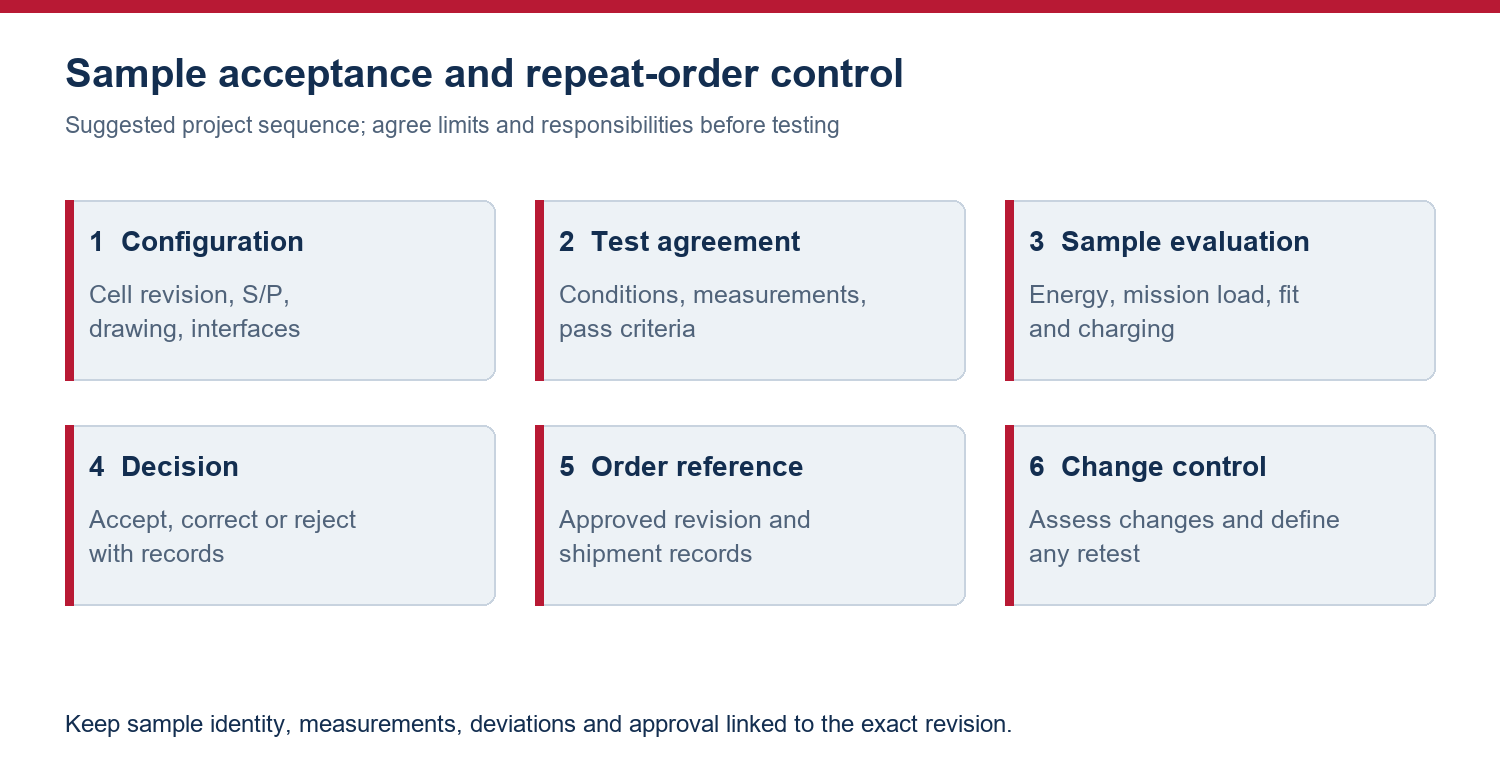
Suggested project workflow. Acceptance limits, test facilities and responsibilities are agreed for the specific configuration.
Check installation, charging and communication
Mechanical checks should cover the defined cell and pack dimensional states, restraint, connector access, lead bend space and removal procedure. A fitted sample is not enough if the drawing omits the dimensional conditions used for the intended life assessment.
ECP11087188-39Ah illustrates the point: its cited specification defines an initial thickness limit of 11 mm at a 2000 gf PPG measurement condition and a 13.2 mm limit after the cycles in section 6.1.2. Use the applicable state when preparing the pack drawing and acceptance checks. Do not assume that these cell measurements already include insulation, restraint or cable clearance. S4
Test charging with the agreed charger model, settings and interfaces. Record start and end states, temperatures, duration and termination. If a fleet relies on several simultaneous charge channels, verify the shared-power condition as well as a single-channel demonstration.
Where communication is required, agree the message definitions, units, update behaviour and response to lost or invalid data. The battery and aircraft teams should evaluate fault responses together. Destructive, abuse or transport qualification testing belongs in an appropriately equipped programme, not an improvised customer acceptance exercise.
Assign responsibilities and resolve deviations
New Journey’s project scope can include cell and configuration review, pack drawing and interface definition, sample supply arrangements and the battery records agreed for the order. The customer provides aircraft requirements, integration constraints and acceptance criteria; aircraft trials and system-level decisions should have a named responsible team. Assign any independent laboratory work separately.
When a sample misses a limit, record the observation and its configuration. Decide whether the cause requires a design change, another test, a corrected requirement or rejection. Do not average a failed critical result into an overall pass. Retest against the revised, agreed configuration and keep the previous result for traceability.
Carry sample approval into repeat orders
The purchase specification should reference the accepted configuration revision, not just a marketing model name. Identify which changes require customer notification and approval, such as cell revision, connector, cable, protection settings or firmware.
Define the production records and incoming checks required for each shipment. Where transport documents are needed, match their model and configuration scope to the shipment and use current applicable requirements. A sample test report does not automatically establish transport eligibility or certification for every pack built from the same cell.
Cycle-life comparisons should also retain their duty, temperature, rest periods and end criterion. Agree how routine operating logs will inform replacement or investigation; do not turn a laboratory cycle count into a universal fleet warranty.
Does sample approval guarantee every future delivery?
It establishes an approved reference. Repeat-order confidence also depends on configuration control, agreed production and incoming records, and an effective process for deviations and changes.
Can one successful flight replace a test plan?
It is useful evidence for that configuration and flight condition. It does not cover untested electrical, environmental, charging or repeat-use conditions.
Send the completed project brief and your proposed acceptance matrix to New Journey. For the overall purchasing sequence, return to the UAV battery procurement guide.
Specification references
The model values cited above come from the following Golden Feather supplier documents. Use the matching approved revision for the ordered configuration.
- (S4) ECP11087188-39Ah, GF-PS-23016 A2, 2024-11-11, pp. 4–7