 NEW JOURNEY
IEEE 4333-2026 and High-Energy-Density Cells for UAV Applications
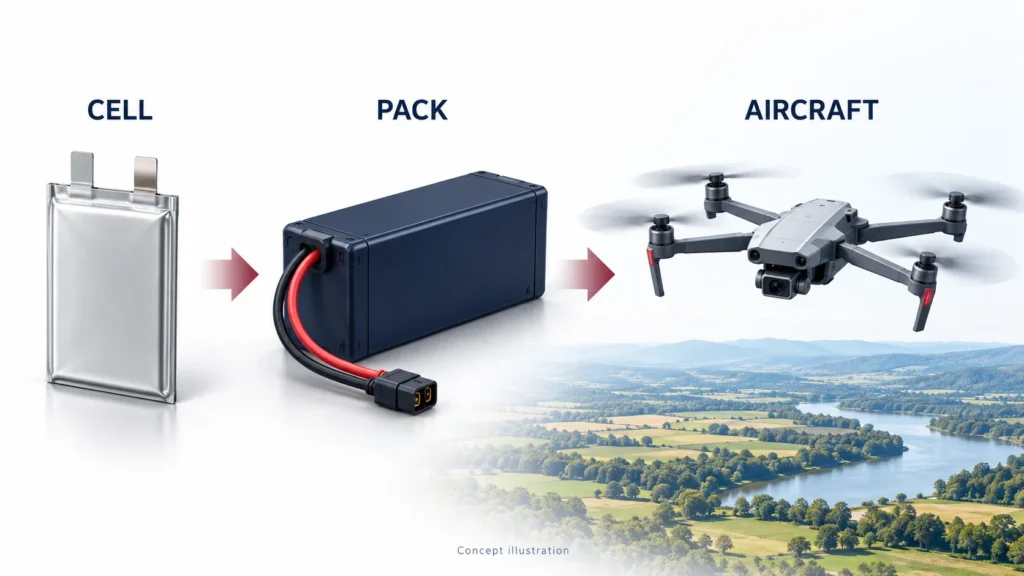
For a mapping drone, more time in the air can mean completing a survey with fewer battery changes. For an inspection aircraft, it can mean spending more time collecting images at the asset. For a delivery platform, battery weight competes with useful payload. Higher-energy-density cells give UAV designers more options when balancing these requirements.
The approval of IEEE 4333-2026 brings a dedicated standards reference to anode-free lithium metal cells and battery packs. Its relevance to UAV development is the opportunity to discuss an emerging cell technology through a common framework while keeping the focus on practical aircraft needs.
What higher cell energy density can offer a UAV project
Specific energy, expressed in Wh/kg, describes how much energy a cell stores for its mass. Volumetric energy density, expressed in Wh/L, describes the energy stored in its volume. A higher value can create useful design opportunities:
- More energy within a cell-mass budget: a route toward longer missions when output, installation and aircraft limits also fit.
- Less cell mass for a given energy requirement: potential flexibility for sensors, payload or the aircraft’s overall weight target.
- More energy within a cell-volume budget: useful for compact fuselages and constrained battery compartments.
These are alternative design choices, not gains that automatically occur together. The priority depends on the mission: endurance, payload and compactness may call for different cell selections and pack arrangements.
Where those opportunities matter
| Application | Customer objective | Battery design focus |
|---|---|---|
| Surveying and mapping | Complete more of a planned survey before landing to change batteries. | Cell specific energy, camera or LiDAR payload, steady-flight demand and return reserve. |
| Power-line and infrastructure inspection | Spend more of the sortie observing equipment and collecting useful images. | Transit and hover demand, sensor mass, voltage stability and operating temperature. |
| Civilian cargo delivery | Balance useful payload with route length and battery weight. | Cell mass, take-off current, changing payload and the aircraft’s permitted operating envelope. |
| Agriculture and field operations | Keep repeated work cycles productive. | Energy alongside loaded output, heat management, battery exchange and charging turnaround. |
| Recreational FPV and compact aircraft | Balance time in the air, handling and available battery space. | Cell mass and size together with transient output and voltage response. |
Energy density is especially useful when stored energy or battery mass is the limiting factor. In a high-current or rapid-turnaround mission, output capability and charging performance may be equally important. Selecting around the actual job helps turn a promising cell into a useful battery configuration.
What IEEE 4333-2026 adds
The IEEE SA catalogue records Board Approval on 25 September 2026 and Active Standard status; its displayed title includes “Approved Draft.” The public scope covers terminology, test conditions, electrical performance, safety and quality-related requirements for anode-free cells and packs.
For a development discussion, this creates a shared reference for describing the technology and discussing evaluation requirements. Product compliance remains specific to the offered model and its applicable documentation.
Why anode-free technology attracts attention
An initially anode-free lithium metal cell is assembled without a conventional negative-electrode active-material layer. Lithium deposits on the negative current collector during charging. Reducing that initial electrode material offers a route toward higher cell energy density.
Research is also improving the way lithium deposits and is recovered during cycling. Recent work on planar lithium deposition and dissolution and tailored charging protocols illustrates this progress. For UAV developers, energy density, cycling and charging therefore belong in the same cell-selection discussion. “Anode-free” describes the electrode architecture; it does not, by itself, mean that the electrolyte is all-solid-state.
From a selected cell to the aircraft
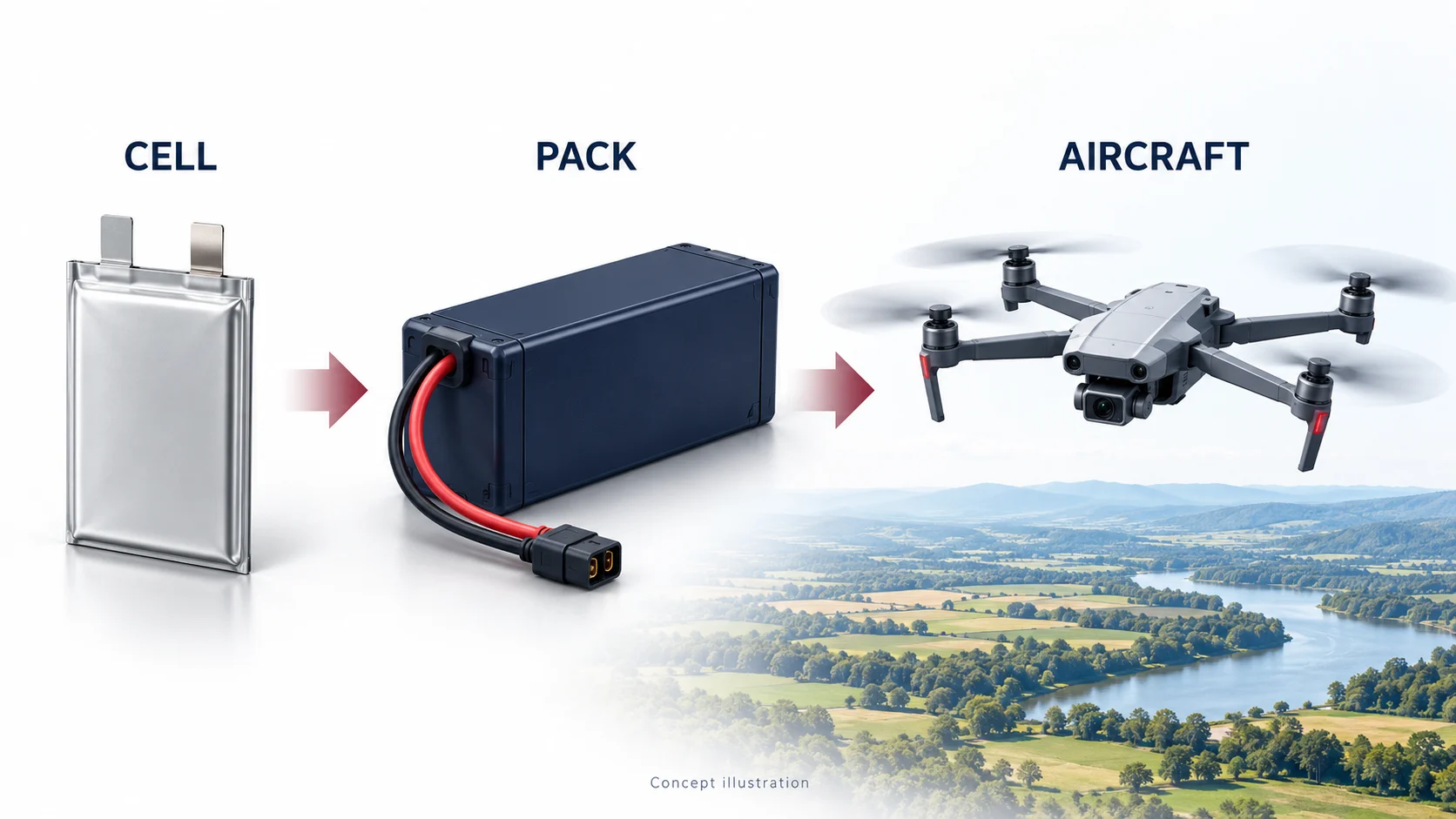
The cell datasheet or cell test record provides the original cell-density reference. Pack design then addresses the series and parallel arrangement, connections, insulation, heat-shrink film, lead exit and any enclosure or electronics. These integration allowances are considered separately from the cell’s own mass and volume.
A practical proposal connects the cell to the aircraft’s voltage window, compartment, current demand and charger. The mission’s usable energy and endurance are then evaluated with the intended payload and operating conditions.
Develop the battery around your application
Xiamen New Journey Technology Co., Ltd. supports customer-specific UAV battery development and configuration. Tell us whether your priority is longer operating time, a lower battery-weight target, more room for equipment or a particular output requirement. Our discussion can then focus on cell selection and a pack configuration suited to that objective.
Explore the drone battery range or read how we approach high-energy-density UAV battery applications and customization. To compare candidate specifications, use the editable battery comparison worksheet.
Discuss your UAV battery project →