 NEW JOURNEY
AGV and AMR Battery Selection: Duty Cycle, Charging and Communication
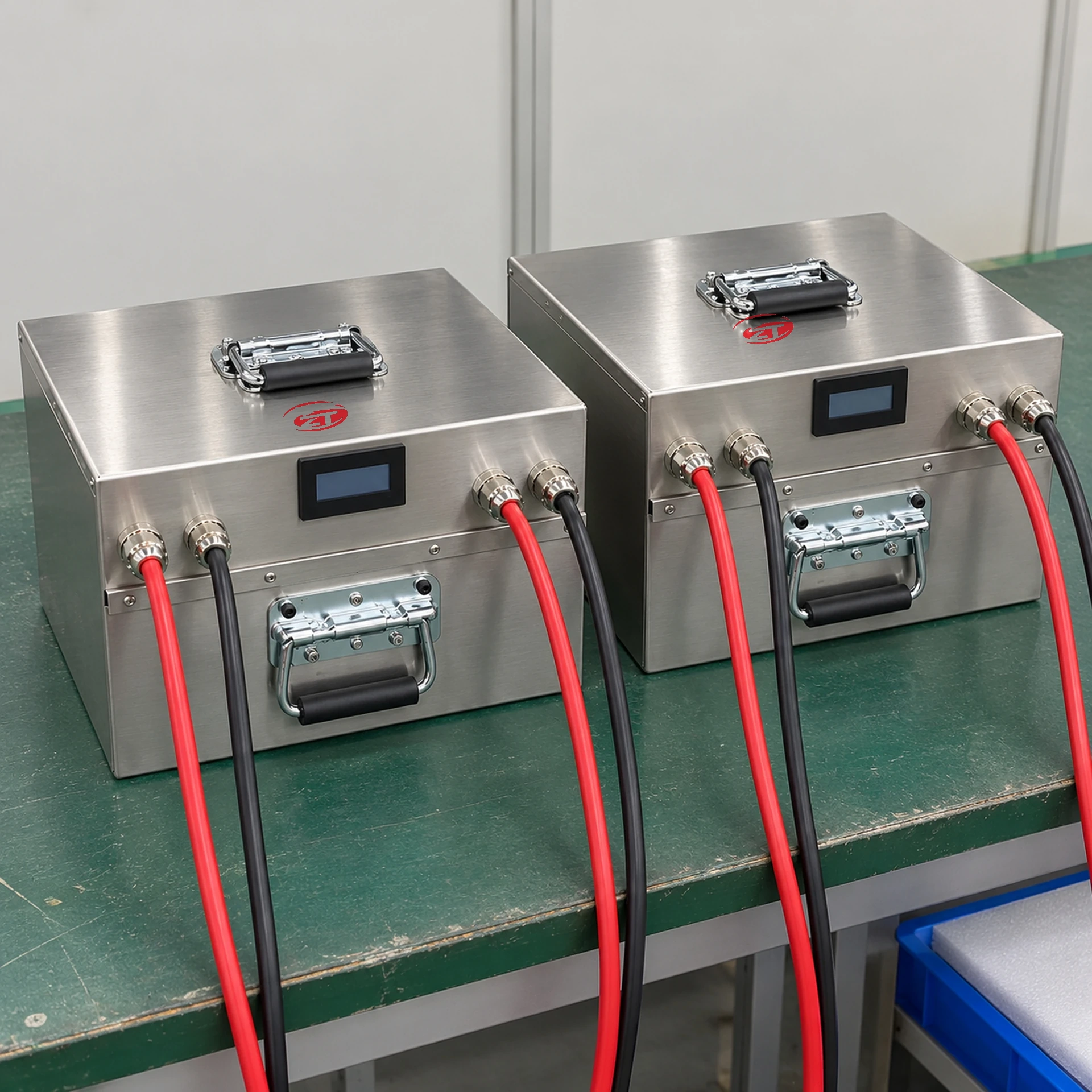
An AGV or AMR battery should be selected around the robot’s working cycle, charging opportunities and control system. Nominal voltage and capacity are only the beginning. A battery that appears adequate on an energy calculation can still interrupt operation if it cannot support acceleration, communicate with the controller or recharge during the available window.
Describe one representative operating cycle
Break the task into movement, loading, unloading and waiting. Include the onboard computer, sensors and communication equipment, which may consume power even while traction motors are idle. Measure at the battery side where possible; otherwise account for conversion losses explicitly. Avoid counting the same loss twice.
The following is an illustrative planning exercise, not a specification for a New Journey battery or a measured robot. It shows how an hour of operation can be assembled from different loads.
| Operating state | Assumed battery-side power | Time in one hour | Energy |
|---|---|---|---|
| Loaded movement | 600 W | 30 minutes | 300 Wh |
| Unloaded movement | 350 W | 15 minutes | 87.5 Wh |
| Loading and waiting | 100 W | 15 minutes | 25 Wh |
| Total | Variable | 60 minutes | 412.5 Wh |
Four repeated hours would require 1,650 Wh before any additional reserve or changes in conditions. This calculation is useful for screening, but it says nothing about the maximum current during acceleration. Evaluate that separately using the robot’s actual demand profile.
Separate energy capacity from power capability
Ask the platform team for continuous current, startup and acceleration peaks, their duration and repetition, and the minimum acceptable input voltage under load. Include lifting or other auxiliary mechanisms. A low daily energy demand does not rule out a demanding short peak.
Texas Instruments’ AGV motor-drive architecture note places battery power within a wider robot control system. Its value here is architectural: the battery, distribution and drives must be reviewed together. It does not establish the components or communication features installed in any New Journey pack.
Check whether opportunity charging is operationally realistic
A scheduled ten-minute stop is not necessarily ten minutes of effective charging. Docking, handshake, charger availability and departure preparation consume part of the window. Charging may also be restricted by temperature, state of charge or the permitted current profile.
Ask the supplier to estimate recovered energy under the intended conditions rather than simply divide Ah by charger amperes. Record the charging equipment, starting state, battery limits and assumptions. Review what happens when a robot misses a scheduled charge or when several robots compete for one charging point. Fleet availability can matter more than the largest nominal capacity in a single pack.
Approve the communication contract
The words CAN or RS485 identify only part of an interface. The robot and battery also need an agreed message definition: identifiers, units, scaling, update rates, state transitions, fault codes and timeout behaviour. Record the software or protocol revision with the hardware configuration.
Ask which party interprets state of charge, permits charging and decides when the robot should stop or return to its dock. Define the response to stale data or communication loss. These are integration requirements to be reviewed by the responsible engineering team; a connector photograph cannot resolve them.
Review protection and recovery as a sequence
Document what the robot should do before a battery reaches its protective boundary, and how it should recover after a controlled stop or power interruption. Include the behaviour of computers, brakes and load-handling equipment. Do not assume that resetting a battery automatically restores a robot to a safe operating state.
At the battery-electronics level, monitoring and protection are related but distinct functions. TI’s BQ76952 documentation illustrates voltage, current and temperature monitoring alongside configurable protection functions. This is a component example, not a declaration that a particular New Journey pack uses that device or offers a particular communications protocol.
Build a sample review around the real route
Use the intended payload, floor conditions, duty sequence and charging workflow. Record the configuration, battery energy use, low-voltage behaviour, temperature observations and charging interruptions. Agree acceptance limits before testing, and keep software changes in the same revision record as hardware changes.
The 25.6V 100Ah AGV battery and 48V 60Ah AMR battery represent different catalogue starting points, not interchangeable solutions. Explore Motive Power Batteries and send the robot duty cycle with your enquiry.
Buyer question: Should every AGV battery have the same communication interface?
No. The required interface follows the robot and charging system. Confirm whether communication is needed, which physical interface is used, and the exact supported protocol rather than assuming a standard option from the application name.
Explore battery selection resources · Discuss your configuration