 NEW JOURNEY
Drone Battery Energy Density: How to Compare Cells for Your Mission

When battery mass limits a drone’s mission, cell energy density is an important purchasing parameter. It helps the buyer compare how much energy a cell can store for its mass or volume. The comparison becomes useful when the figure is tied to the exact cell, its specification revision and the conditions used to measure energy.
The first rule is to keep the measurement level consistent. Cell energy belongs with cell mass or cell body volume. An assembled battery also contains connections, insulation, leads, wrapping, restraint and possibly electronics or an enclosure. Its mass and external dimensions cannot be used to reverse-calculate or disprove the original cell energy-density figure.
Wh/kg and Wh/L answer different questions
Specific energy in Wh/kg relates energy to mass. Volumetric energy density in Wh/L relates energy to volume. A mass-constrained aircraft and a narrow battery compartment may therefore need different comparisons.
| Measure | Matched quantities | Useful purchasing question |
|---|---|---|
| Cell Wh/kg | Cell energy divided by cell mass | How much energy can the selected cells contribute within a cell-mass allowance? |
| Cell Wh/L | Cell energy divided by cell body volume in a stated condition | How much energy is stored in the available cell volume? |
| Pack Wh/kg | Pack energy divided by complete pack mass | How does the finished battery meet the aircraft’s installed mass limit? |
| Installation envelope | Finished pack plus required connection and service clearance | Will the battery fit, connect and remain properly supported? |
Installation clearance is not cell volume. Lead bends and connector access may increase the space an aircraft needs without changing the cell’s original volumetric energy density.
Distinguish a nominal comparison from a tested rating
A nominal comparison can use rated amp-hours multiplied by nominal voltage, divided by nominal cell mass. It is useful for initial screening when all inputs belong to the same cell. It is not the same as integrating voltage and current over a defined discharge test, and it is not automatically a supplier-guaranteed minimum.
The following table uses six Golden Feather cell specifications supplied for New Journey project evaluation. The specifications provide the underlying capacity, voltage and mass; the final column is explicitly a nominal calculation. The cited individual documents do not separately state the calculated values as guaranteed Wh/kg ratings. S1–S6
| Cell and cited revision | Nominal cell energy | Nominal cell mass | Nominal energy / mass |
|---|---|---|---|
| AEP8390192-49Ah, A2 | 49 × 3.8 = 186.2 Wh | 0.390 kg | 477.4 Wh/kg |
| FAP10790192-22Ah, A0 | 22 × 3.75 = 82.5 Wh | 0.411 kg | 200.7 Wh/kg |
| FAP105105230-30Ah, A1 | 30 × 3.75 = 112.5 Wh | 0.559 kg | 201.3 Wh/kg |
| ECP11087188-39Ah, A2 | 39 × 3.6 = 140.4 Wh | 0.430 kg | 326.5 Wh/kg |
| PCP10090192-20Ah, A0 | 20 × 3.7 = 74.0 Wh | 0.354 kg | 209.0 Wh/kg |
| PCP104136260-45Ah, A1 | 45 × 3.7 = 166.5 Wh | 0.764 kg | 217.9 Wh/kg |
Each cited cell mass has a ±5 g tolerance. The displayed comparison uses the nominal mass, not a guaranteed worst-case denominator. For a purchased minimum specific-energy requirement, agree the energy test, mass measurement, tolerances and acceptance method with the supplier.
The catalogue dated 25 September 2025 separately describes the Wuji series at 450–550 Wh/kg, the agricultural series at approximately 210 Wh/kg and ECP products under a “340 series” heading. Those are attributed series descriptions. Keep them separate from model-specific test results and the nominal arithmetic above; a difference in presentation does not by itself demonstrate that the original cell claim is wrong. S9
Apply the comparison to the mission’s current demand
A high Wh/kg value does not show how much power the cell can deliver at the required time. AEP49Ah’s cited maximum discharge is 1C at 0–45°C, with at most 0.3C in the −20–0°C range. ECP39Ah’s cited maximum discharge is 5C, with a 7C peak for 10 seconds. These are substantially different electrical constraints. S1, S4
For an illustrative 61.1 A demand lasting two minutes, a 49Ah 1P cell path limited to 1C would not pass the current screen. Its greater nominal energy does not remove that limit. A different parallel configuration might be investigated, but its mass, volume and pack design would need reassessment.
Conversely, a mission with modest output and a tight mass allowance may place greater value on specific energy. The decision should follow the application: compare candidates only after stating current, duration, voltage limits, temperature and reserve needs.
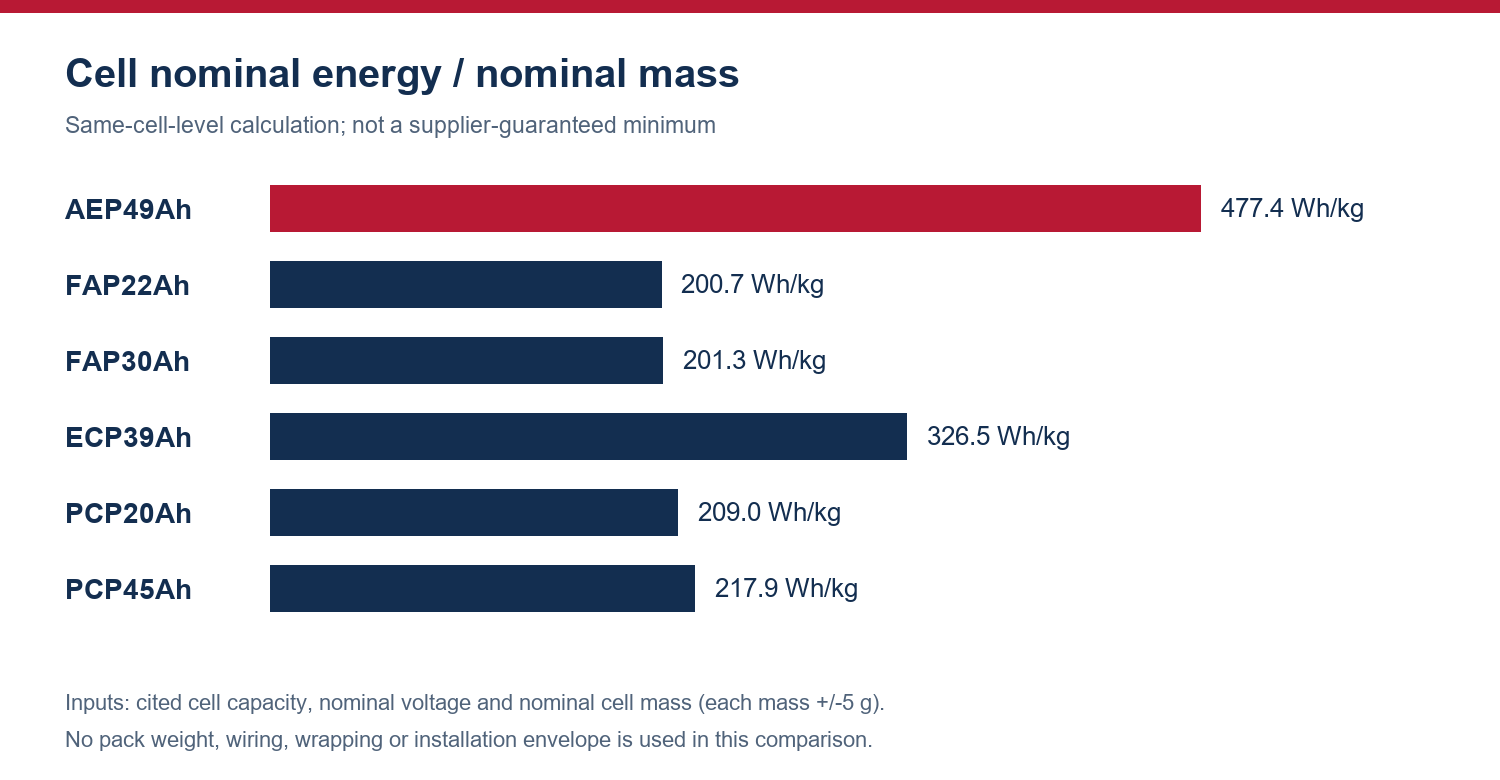
Calculated from each cited cell’s nominal energy and nominal mass. No pack measurements are used; the chart does not represent discharge testing or guaranteed minima.
Compare energy under the conditions that matter
For a technical comparison, request the discharge current or power profile, test temperature, upper and lower voltage limits, starting condition and sample age. Record whether the energy was measured at cell or pack level. Usable energy to an aircraft’s operating limit may differ from a laboratory capacity test that ends at a lower voltage.
Cycle life also needs its operating conditions. AEP49Ah’s cited discharge-performance clause specifies more than 80% capacity retention after 20 cycles at 0.3C, 25 ±3°C and 0 MPa. It should not be silently converted into a different service-life promise. Select the test duty and retention requirement that match the procurement objective. S1
For Wh/L, use a defined cell-body measurement state. State of charge, restraint or measurement force, and cycling history can matter to the dimensional definition. ECP39Ah, for example, specifies different initial and post-cycle thickness limits. Without matching volume conditions, a volumetric comparison can mix physically different states. S4
Turn the shortlist into a pack enquiry
Once a cell direction is selected, the pack designer must allocate mass and space for the remaining components. That is a separate integration exercise. A heavier finished pack does not invalidate a valid cell-level density figure, but it may change which configuration works in a particular aircraft.
New Journey can use the shortlist to discuss series and parallel arrangement, capacity, installation geometry, leads, connectors and the required sample programme. Include the preferred cell specification revision and explain whether mass, available volume, output or service life is the leading constraint. This makes the enquiry actionable without assuming that a cell automatically corresponds to an existing finished-pack SKU.
Is the highest Wh/kg cell always the best drone cell?
It is a candidate for a mass-limited energy requirement. The selected configuration must also satisfy current, duration, temperature, life and installation requirements.
Can I calculate Wh/L from a finished battery photograph?
No. A photograph does not establish the cell body’s dimensions or state. Use matching cell measurements or a supplier’s defined cell-level result.
Does a chemistry or “solid-state” label establish density?
No. Use the exact model’s specification or test result. A technology label alone does not supply the energy, mass, volume or operating conditions needed for the comparison.
Continue with the long-endurance application solution, or send the project brief to New Journey for a configuration discussion.
Specification references
The model values cited above come from the following Golden Feather supplier documents. Use the matching approved revision for the ordered configuration.
- (S1) AEP8390192-49Ah, GF-PS-24032 A2, 2024-11-19, pp. 5–7
- (S2) FAP10790192-22Ah, GF-PS-25008 A0, 2025-02-21, pp. 5–6
- (S3) FAP105105230-30Ah, GF-PS-24026 A1, 2024-11-11, pp. 5–7
- (S4) ECP11087188-39Ah, GF-PS-23016 A2, 2024-11-11, pp. 4–7
- (S5) PCP10090192-20Ah, GF-PS-25069 A0, 2025-06-04, pp. 4–7
- (S6) PCP104136260-45Ah, GF-PS-25038 A1, 2025-06-03, pp. 4–7
- (S9) Golden Feather cell catalogue, 2025-09-25, pp. 1–2